
Scordatura
Soundtrack to Hellworld #2

Below is the third entry in the “Soundtrack to Hellworld” series, covering Chapter 2, “Crust of the Earth.” Chapter 2 is primarily theoretical, exploring the emergence of capitalist society’s “technical exoskeleton,” understood as only one part of a larger social-metabolic transformation of the planet. Among the chapter’s major themes is the supervening force of sociotechnical systems over the human body and the physical environment and the need to see through ideological theories of technological determinism to perceive the social powers at play in this process. To do so, we have to take our minds out of tune with the “common sense” of our own anthropological environment.
In other words, this requires a theoretical practice capable of “seeing through” ideology, which is not simply “false” but instead an active element in the material reproduction of our social world. In Žižek’s now-classic formulation:
ideology is not simply a “false consciousness”, an illusory representation of reality, it is rather this reality itself which is already to be conceived as “ideological” – “ideological” is a social reality whose very existence implies the non-knowledge of its participants as to its essence -that is, the social effectivity, the very reproduction of which implies that the individuals “do not know what they are doing.”[1]
…
Ideology is not a dreamlike illusion that we build to escape insupportable; in its basic dimension, it is a fantasy-construction which serves as a support for our reality itself; an illusion which structures our effective, real social relations and thereby masks some insupportable, real, impossible kernel.[2]
Theoretically dismantling ideology requires not simply recognizing it as false, then, but also as an active material force in the world and, moreover, as a malicious expression of class domination. For this reason, Žižek often likens the process to the premise of John Carpenter’s sci-fi horror classic They Live!, in which a pair of magic sunglasses allow the protagonist to see the secret propaganda embedded in the everyday environment by an occluded class of alien overlords who are depleting the planet’s resources and using global warming to transform it into a world like their own. Notably, the ideological veneer is projected into people’s minds through popular media, transmitted via a special signal broadcast from a television station.
In this trope, “seeing through” ideology therefore requires a technology (in the movie, magic sunglasses, but for Žižek, critical theory) that allows the mind to fall out-of-tune with the ideological “signal” being broadcast by those in power, portrayed here as an electromagnetic wave. In classical music, “scordatura” (lit. “dissonance) describes a similar technique: the intentional mistuning of a string instrument that allows for unusual effects, making audible otherwise imperceptible chords. The technique became common in the Baroque period, and its invention is usually attributed to middle-Baroque composer Thomas Baltzar. Notably, this was the same time period in which common practice tonality was itself formalized. The technique therefore expressed a basic tension between artistic experimentation and the ordering of artistic practice.
The method of scordatura evolved within the broader current of the counter reformation, of which the Baroque was the major artistic expression, encapsulating the social contradictions of the era:
Baroque mirrored the contours of social and political crisis — the Protestant uprising across Northern Europe and the Catholic Church’s campaign to win back lapsed Christians by encouraging a more effusive, personal, and embodied religious expression … In proximity to the body and its sensorial experience and antithetical to the realism of Renaissance Italy, Baroque offered a “vitality, movement and emotional force of the kind which periodically causes an upheaval in the arts,” wrote Glissant. This sentiment appealed to artists and musicians who, emboldened by the visions and finances of the Catholic Church, were commissioned to adorn their buildings in a triumphant mode of propaganda against the stringency of Protestantism.[3]
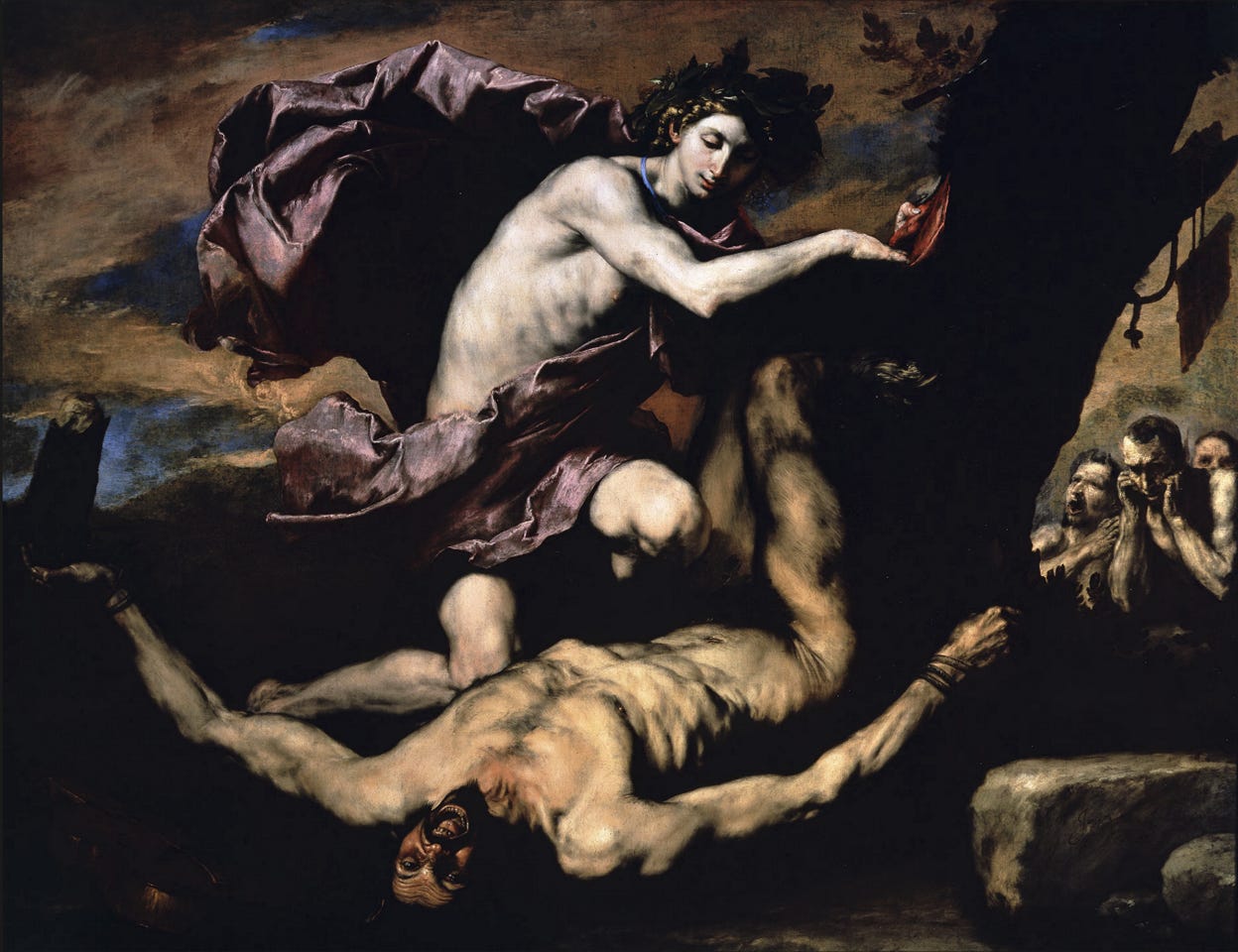
In this sense, we might see the experimentalism buried within Baroque music as similar in kind to the queer and feminist undercurrents of work by Baroque painters like Caravaggio and Gentileschi.
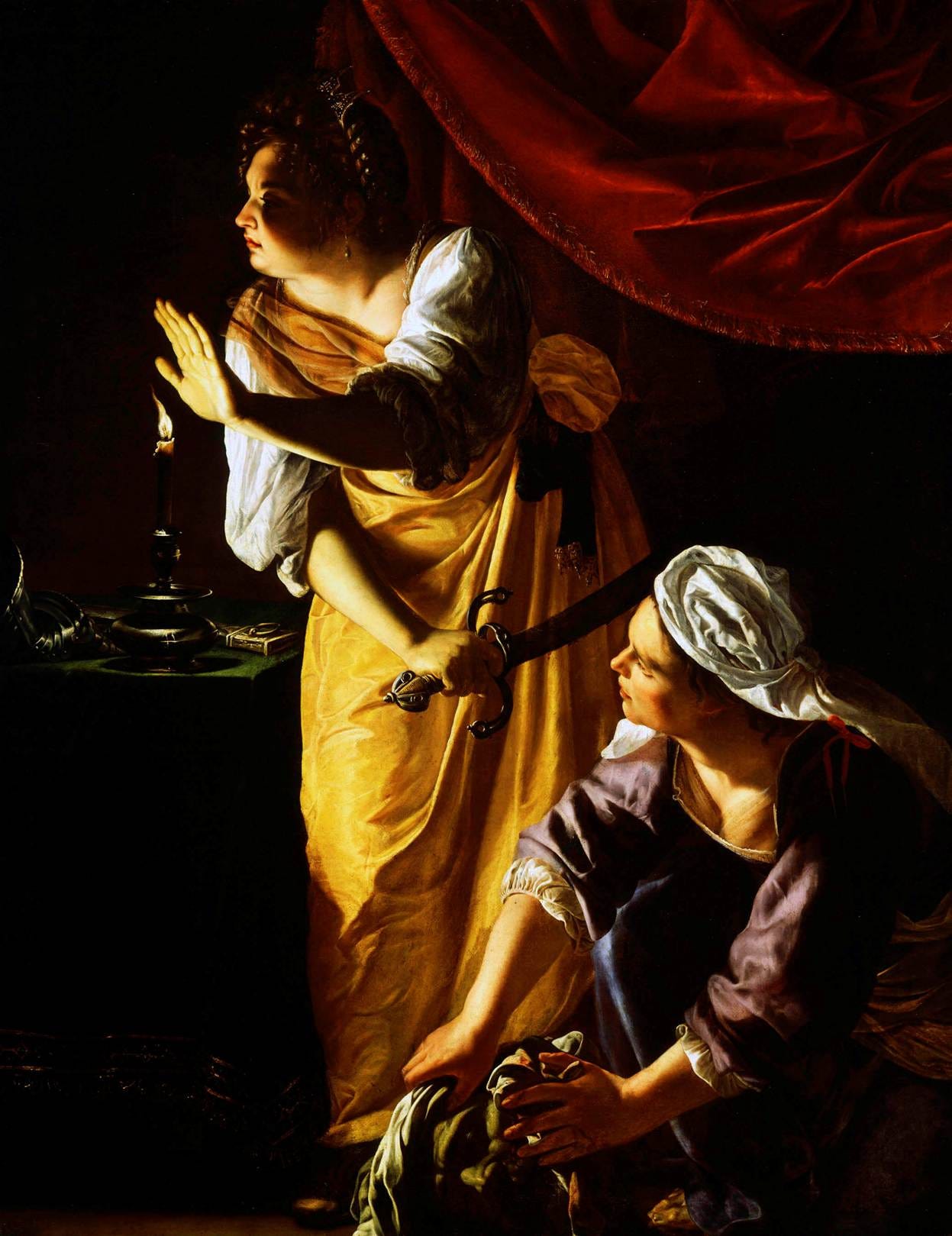

While somewhat subterranean, these undercurrents are nonetheless an expression of the central contradiction of the Baroque itself:
Baroque is defined by a crisis — one that assumed and capitalized on excess and proliferation, against Protestantism but also the rationalism of Renaissance men like Da Vinci and Michelangelo with their precise and calculated measurements. It spoke to and of power but also sensuality, sexual liberalism, and feeling, the illusory nature of things, and the theater of life … In proximity to the papacy and their payroll, artists and musicians infiltrated the zeitgeist with these ideas and traveled with them to Mexico and outposts of the Mediterranean, making room for Baroque’s versions and sisters. What became cultural “inputs of a novel kind” had begun as “revolutionary disfigurements of reality” — or Western conceptions of reality. Glissant writes that “a first manifestation of this expansion was undoubtedly to be seen in Latin American art, so close to Iberian and Flemish Baroque, yet so intimately interwoven with indigenous elements, daringly introduced into the baroque concert.”[4]
In other words, the Baroque represents how the contradictions intrinsic to any given ideology produce immanent forms of dissonance that can be made into a technology of experimentation—scordatura as technique—which, as a subjective project, simultaneously serves as a technology of critique, opening the mind to novel possibilities foreclosed by the prevailing tonality of the status quo.
The following playlist is, therefore, organized around the Baroque and, more specifically, around Baroque composers known for their use of scordatura or other somewhat experimental techniques. Foremost among these are Heinrich Ignaz Franz von Biber, whose “Mystery Sonatas” took scordatura methods to the extreme:
Rather than keeping the violin strings tuned to the notes G-D-A-E as is typical, Biber has a different tuning for each of the fifteen sonatas. In ‘The Visitation’ the strings are tuned A-E-A-E, ‘The Nativity’ is B-F sharp-B-D, and so on. Of particular note is ‘The Resurrection’, tuned G-D-G-D: Biber asks for the two middle strings to physically cross over, making the sign of the crucifix visible on the instrument.[5]
My personal favorite rendition of Biber is that of Alice Piérot (2003). Though not available on Spotify (and therefore not included in the playlist below), you can listen to the whole thing here:
Alongside Biber is Barbara Strozzi, known for a sophisticated use of unprepared vocal dissonance and a hyper-textual approach to her compositions. Strozzi’s work arguably even gestures toward certain features that would later come to be associated with the modernist turn:
She employed unprepared dissonance to express the extreme emotions she conveyed in her music and wrote dissonances between the voice and accompaniment in order to convey the depth of emotion and color the text dramatically. Her compositions were typically more modal than tonic-dominant. She played with form and would shift between recitatives, arias, and ariosos regardless of how the text was written and divided.[6]
Though I include an instrumental version of Strozzi’s Che si può fare in the playlist below (because I personally love this particular rendition), you can see classical vocalist Mariana Flores perform the traditional vocal version here:
The playlist also includes a number of better-known Baroque composers such as Purcell and Scarlatti. I haven’t included any Bach, however, as the average “Baroque” playlist tends to be weighed down by the cliché of Yoyo Ma performing the Cello Suites. Nonetheless, readers who want a Bach playlist should explore this stunning series by harpsichordist Pierre Hantai (be careful typing his surname into Google), performed for the Netherlands Bach Society:
Finally, the playlist then progresses from the Baroque into the modern, with the divide marked by Penderecki’s “Threnody for the Victims of Hiroshima,” recently re-popularized by its use in David Lynch’s Twin Peaks: The Return. The version used below is a more recent rendition by Jonny Greenwood. But the scene from Twin Peaks is a must-watch as well:
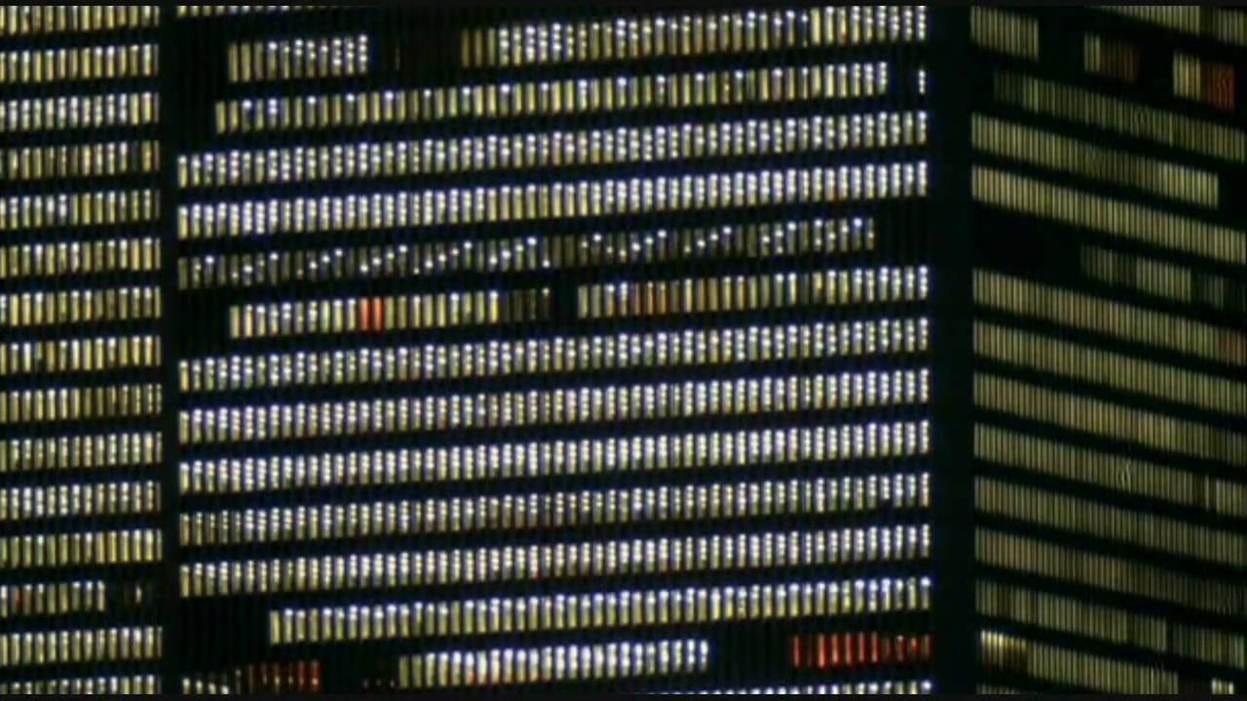
Threnody is followed by a series of 20th and 21st century composers whose themes, taken together, express the emergence of a planet-spanning sociospheric system instantiated in a “technical exoskeleton” of vast industrial infrastructure and glittering megacities. Respighi, Roslavets, and Schoenberg illustrate the alternately romantic and chaotic drive of modernity, while Ryuichi Sakamoto, Ólafur Arnalds, and Philip Glass embody its apotheosis in a serialized, electrified grid of anthropic flows. In particular, the piece by Glass chosen here is a composition for the 1982 film Koyaanisqatsi by Godfrey Reggio, which remains perhaps the best cinematic depiction of the themes explored in “Crust of the Earth.” You can find a somewhat low-resolution version on YouTube:
In particular, see Reggio’s depiction of the “grid” of urban space:


The Baroque of the sensuous body wracked by the sublime torment of a divinity just behind the veil becomes the Baroque of the machine threshing through senseless stone and bleeding flesh in service of a grand, inscrutable ritual:
[1] Slavoj Žižek, The Sublime Object of Ideology, New York: Verso, 1986. p.16
[2] Ibid p.45
[3] Rose Higham-Stainton, “Baroque as Being”, Flash Art, 03 June 2024. <https://flash---art.com/article/critic-dispatch/>
[4] ibid
[5] James Hardie, “Heinrich Biber – Composer of rapture and ravings”, Engelsberg Ideas, 19 May 2021. <https://engelsbergideas.com/portraits/heinrich-biber-composer-of-rapture-and-ravings/ >
[6] “Barbara Strozzi,” The Modern Reveal, 2025. <https://www.amodernreveal.com/barbara-strozzi>