
Broken Circles
Soundtrack to Hellworld #11


Below is the tenth entry in the “Soundtrack to Hellworld” series, covering Chapter 10 of the book, “The Diffraction of Africa,” which focuses on the postwar developmental history of Sub-Saharan Africa and, in particular, East Africa, as well as the curious condition of “premature deindustrialization” being experienced across much of the continent today. The chapter follows several threads of argument. Drawing from work like Adom Getachew’s Worldmaking After Empire, it briefly traces out a lineage of Fabian developmentalism, epitomized by both African socialist figureheads like Nyerere and traditional left-liberal developmentalists like W. Arthur Lewis, and which drew heavily from the Latin American structuralist wing of dependency theory. The chapter then moves on to explore the consequences of this path, which attempted to balance integration with the global market and protectionist industrialization in much the same way as in East Asia, but with very different results – due, in part, to the absence of the US military inputs that kept the postwar economies of Japan, Taiwan, South Korea, Thailand, etc. afloat, but also due to key differences in the program of structural transformation itself as well as the absence of adequate insulation against the global financial system.
These differences became manifest in the Third World Debt Crisis, which then led to what Giovanni Arrighi referred to as the “African Tragedy.” Writing in 2002, Arrighi offered an apt summary of the outcome:
In 1975, the regional GNP per capita of Sub-Saharan Africa stood at 17.6 per cent of ‘world’ per capita GNP; by 1999 it had dropped to 10.5 per cent. Relative to overall Third World trends, Sub-Saharan health, mortality and adult-literacy levels have deteriorated at comparable rates. Life expectancy at birth now stands at 49 years, and 34 per cent of the region’s population are classified as undernourished. African infant-mortality rates were 107 per 1,000 live births in 1999, compared to 69 for South Asia and 32 for Latin America.
As some of the latter figures suggest, however, the so-called “Third World” Debt Crisis ultimately resulted in the diffraction of the “Third World” itself. While it was possible, in the postwar period, to gesture at broadly similar conditions of life in areas as disparate as Latin America, Sub-Saharan Africa, and across much of Asia, by the turn of the millennium these areas had all drastically diverged from one another in their developmental outcomes and had grown to occupy drastically different positions in the global hierarchy of production.
From here, the chapter then explores recent developmental trends across the continent in more detail, elaborating on the concept of “premature deindustrialization” and exploring its geographic and political consequences. My ILWCH piece “Broken Circle: Premature Deindustrialization, Chinese Capital Exports, and the Stumbling Development of New Territorial Industrial Complexes,” explores the concept in more detail than the chapter, arguing that the numerous circuits of traditional patterns of industrialization structured by forward-and-backward supply chain linkages are beginning to break down, marking also the point at which the developmental drive has circumnavigated the globe. The term “premature deindustrialization” itself was popularized by the economist Dani Rodrik in an NBER paper of the same name. Rodrik defines the phenomenon as follows:
What developing countries are experiencing today is appropriately called “premature deindustrialization,” a term that seems to have been first used by Dasgupta and Singh (2006). In most of these countries, manufacturing began to shrink (or is on course for shrinking) at levels of income that are a fraction of those at which the advanced economies started to deindustrialize. These developing countries are turning into service economies without having gone through a proper experience of industrialization.
Further empirical studies were then performed by Rodrik and others to prove the trend. For example: Diao et al. 2019, and Diao et. al. 2022. In “Broken Circle,” I explains the significance of premature deindustrialization as follows:
By jumping from agricultural subsistence to mass urban employment in services, countries thereby experience a “premature” structural shift relative to total output. This is a problem for two reasons: First, the linkage between output growth and employment is the economic basis for many of the positive features of development, enabling rising wages and rising taxation to fund social services, and encouraging widespread investment in basic education. Second, output growth in the industrial sector continues to increase, meaning that premature deindustrialization also prematurely limits the positive outcomes of development even while it is still accompanied by many of its negative externalities, such as environmental pollution and mass eviction conducted in the name of urban development… But an important caveat is that industrial output (especially in manufacturing and construction) still increases in these places, even if not as fast. This is important precisely because it diverges both from the traditional expectations baked into orthodox developmental models and from the accounts of underdevelopment and failed industrial takeoff offered by critical development theorists
In addition to being significant for development studies, however, the trend is also a crucial feature of contemporary political conflicts. Hellworld explores these political consequences in some detail, demonstrating how the unique conditions established by premature deindustrialization transform both the prospects of building a traditional “worker’s movement” founded on the growth of industrial employment in the cities and the hope of returning to the countryside to organize among the peasantry in the fashion of the 20th century revolutions in places like China and Vietnam. Instead, we find conditions in “developing countries” that resemble those of “developed countries” in certain key respects (namely atomized employment in the service sector) but which also take these same trends to the extreme, resulting in overcrowded informal settlements, mass unemployment among youth, political control over the much smaller share of industrial and professional jobs (which creates ensuing patronage structures), degrarianization, and rapid urbanization.
One great companion piece for “Broken Circle” and the Hellworld chapter is “The Long, Slow Death of Global Development” by David Oks and Henry Williams, who also draw out the political consequences quite clearly:
The casual work ubiquitous in the poor world does not represent a cure to mass unemployment, but instead a mass underemployment: the line between a casually employed jobber and an unemployed person is a very thin one, even if statistics distinguish between the two. Poor-world economies are thus afflicted by a remarkable superfluity of labor, with too many workers and far too few good jobs to put them in. It is this abundance of cheap labor that leads to unproductive uses of that resource: it is what allows middle-class Pakistani families, for instance, to routinely afford several domestic servants, or what leads to the ubiquitous presence of the listless youth termed, in Arabic, hayateen—“the men who lean against walls.” The desperation for formal employment is everywhere in these societies, leading to incredibly fierce competition even for entry-level positions: in 2015, the state of Uttar Pradesh in northern India put out a notice to fill 368 clerical jobs, and received 2.3 million applications. Tales of the horrific job market in India, in particular, are legion: screenings for jobs with companies like Qatar Airways regularly attract thousands of applicants, who form huge throngs outside the interview center before being sent home en masse without having been seen.
As explained in the previous chapter, wahuni is the Swahili equivalent of the Arabic hayateen, at least as a political colloquialism expressing anxiety over masses of unmoored, underemployed youth drawn in on waves of urbanization and stranded without much to do. And, of course, these were precisely one of the key populations that drove both the first and second Arab Springs and which populate the world’s black market and mercenary economies, as explored more in the subsequent chapter of Hellworld. According to Oks and Williams:
Thrown off by agriculture and industry, never fully occupied by service work, the economic problem of superfluous labor soon becomes a social one. Unoccupied and discontented, hayateen are the ideal destabilizers of Third World societies. The link between “youth bulges,” high youth unemployment, and social unrest has been studied for decades, and only those societies that have significantly reduced youth unemployment have managed to avoid it. At the problem’s extreme, these discontented youth became foot soldiers for a variety of criminal or insurgent groups competing with the state for sovereignty: MS-13 in El Salvador or Honduras, the narco groups of Mexico or Colombia, G-9 and other gangs in Haiti, Islamist groups like Boko Haram or the Islamic State in the Muslim world. (The name of Somalia’s al-Shabaab—“the youth”—is representative.) More mundanely, these unemployed and underemployed youth provide the manpower for criminal violence and urban rioting, from the sozaboy subcultures of northern Nigeria to South Africa’s “Zuma riots” or the occasional spates of communalist slaughter in Indian cities. Other destabilizing factors, like the flood of high‑caliber weaponry into poor countries after the collapse of the Soviet Union (and again after the fall of the Gaddafi’s Libya in 2011), and the arrival of a novel informational modernity through cellphones and the internet, have only heightened the destabilizing potential of these new forces—especially when pitted against increasingly emaciated states, hardly able to govern their own territories.
Alongside “graduates with no future,” the wahuni or hayateen are obviously key players in modern political dynamics. Some theorists have attempted to capture this dynamic within the traditional coordinates of “the lumpen,” thereby emphasizing the “declassing” of this population while also reviving the language used by figures like Huey Newton and Franz Fanon to portray them as a potential revolutionary vanguard. And yet associations of professionals have been just as, if not more, central to revolutionary dynamics in places like Sudan. Meanwhile, for all the stress on “informality,” “precarity,” and the divergence from developmental norms, the reality is that proletarian existence has always been defined by many of these exact same conditions. Thus, the mistake seems to be in idealizing historical myths of “workers” and “peasants” that only had any reality in brief, somewhat exceptional periods of war and development. What is needed is, quite obviously, a politics oriented toward the proletariat as it has always existed: a class defined by its dispossession.
What might this politics look like? The obvious point is that it must embrace and operate within the existing dynamics of political conflict being generated by this global proletariat, visible in recurrent, somewhat nihilistic bouts of mass rioting and insurrection that target the alienated appearance of power in its political form and, therefore, have met their most severe limits in their very successes: toppling governments only for the same old cabals of economic elites to perpetuate their power through new political and military channels. As is explained more in the final chapter of the book, the Sudanese case represents perhaps the most advanced attempt to overcome these limits through the restructuring of daily live via the resistance committees. Nonetheless, communist organization begins wherever the existing organization of the class ends and must, therefore, engage with these conflicts and formulate theories of their limits, practical suggestions for how such limits might be overcome, and organizational bodies capable of experimenting with these practices in living struggles. This is not a matter of simply criticizing the failure of such movements from the outside but instead of an immanent critique made by communists caught up in their currents.
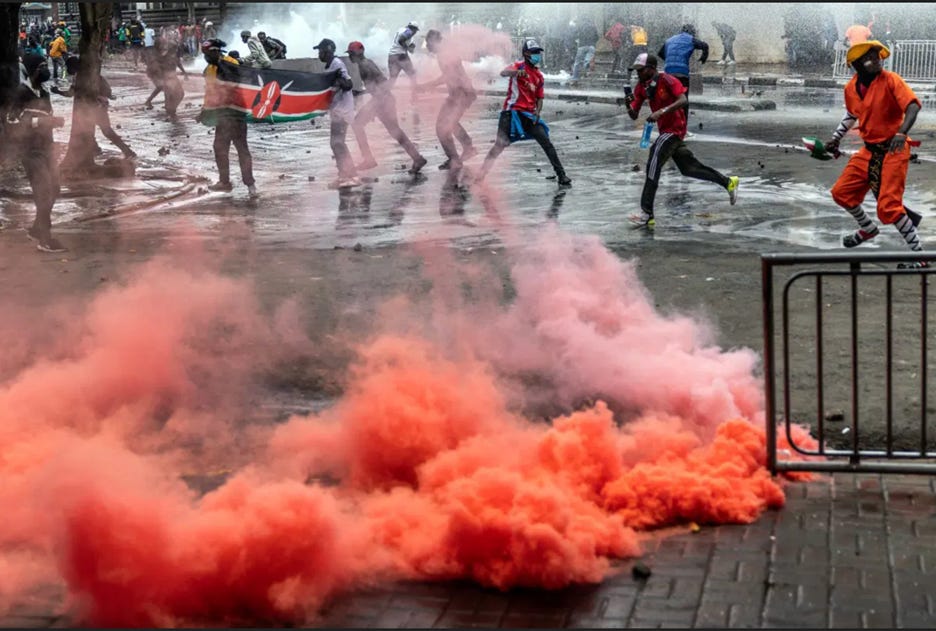
For this reason, the chapter begins with the political scene in Kenya in 2024 as mass protests against the proposed Finance Bill saw youth storm parliament and police respond with deadly force, killing 50-60 people, injuring hundreds, and disappearing activists. It doesn’t go into enormous detail on the events, however, simply drawing some structural points from policy commentator Ken Opalo, whose An Africanist Perspective is worth following.

Notably, the Kenyan protests can be classed alongside similar protests in places as far afield as Madagascar, Bangladesh, and Serbia as “Gen Z Uprisings.” Obviously, the implication is that these protests have a generational component driven by inequities of access to work and other opportunities that map onto age. In almost all cases, they also mark key cultural inflection points, in the sense that they often refuse to articulate politics in the conventional fashion used by previous generations. In the Kenyan case, this takes the shape of young protestors largely rejecting the ethnicized politics that have structured much of the country’s postcolonial political history. I say ethnicized here because this has nothing to do with ahistorical “ethnic” or “tribal” divides but is instead a dynamic and entirely modern system of political patronage constructed out of the lineaments of the “tribal” administrations created for indirect rule in the colonial era, which incentivized the exaggeration and even creation of ethnic difference and the construction of ad hoc pseudo-indigenous social hierarchies (i.e. “chieftainships”) that often had little link to customary practices. See, for example, the introduction of the “chief” system to the chiefless societies of North-Western Ghana. For the Kenyan case, this paper by Stephen Irungu provides a useful overview. Elsewhere, this generational upsurge was expressed as a break with established patronage systems linked to ruling parties that, in the Baathist pattern, also controlled the pool of formal jobs linked to the civil service and core industries like oil or mining.
For this reason, many of the Gen Z revolts have even taken on a mildly conservative character, demanding greater liberalization and more competitive markets that better value professional skills, all posed against what, in Thailand, has long been referred as the “bureaucratic polity” and which, as elsewhere, takes the form of a vast corporate-military-bureaucratic oligopoly. This impulse is undoubtedly one of the reasons why such revolts have, like those of the 2010s, tended to result in little more than a shift of power to nominal opposition figures or, at best, to temporary rule by a military council. In other words, even in their most radical form, many participants continue to see their conditions as failures of the market or of prevailing political institutions, which must therefore be rectified by some populist opponent or general, rather than as products of the market economy itself. Notably, Kenya’s Ruto himself was propelled into power by these very anxieties, as youth were fed up with the back-and-forth between the country’s twin political dynasties. In reality, however, the very conditions of premature deindustrialization in employment are driven precisely by “development,” visible in rising industrial output and swollen property markets. But these dynamics then also generate the illusion of a “crony,” “political,” “neoliberal,” or even “neo-feudal” capitalism that can be rectified simply by slicing off the adjective and restoring capitalism to its supposedly true form of a “market economy” optimized by the “innovation” of “entrepreneurs” to adequately value “human capital.”
Unfortunately, the chapter does not have time to delve deeply into political conditions in Kenya or on the details of revolutionary history across Sub-Saharan Africa or the African Marxist tradition. For the former, the Sheng-language podcast Until Everyone Is Free is an absolute must-listen, with English transcripts on their website and English subtitles posted on their YouTube channel, which also has a number of follow-up “Beyond the Bill” episodes, focusing on the aftermath of the 2024 protests:
In addition to its core series on the nature of capitalism and the political-economic history of Kenya:
As well as this excellent one-off episode on the AI training and data moderation industry, cited heavily in the advance drafts of my forthcoming book project on the industry:
Today, all of these trends are not only producing new forms of political conflict and new forms of underdevelopment but also new geographies of uneven development across Kenya and the continent as a whole. The chapter quotes from Achille Mbembe, who describes these conditions as follows:
between the years 1980 and 2000, an atomized capitalism, unaccompanied by any agglomeration or enormous centers of growth, developed on the ruins of a revenue economy dominated by state companies, controlled by the clientelist systems in power and by monopolies dating back to the colonial era of captive markets. The dichotomy between urban economy and rural economy and between formal economy and informal economy that characterized the moment immediately following the end of colonization exploded. These dichotomies were replaced by a patchwork, a mosaic of spheres—in short, a diffracted economy, comprising various, more or less intertwined, sometimes parallel, regional nodes that maintained changing and extremely volatile relations with international economic networks. A multiplicity of eco nomic territories, often within the same country, sometimes nested within one another and often disjointed, is emerging out of this extreme fragmentation.[1]
The result is that Africa itself now appears to be undergoing an process of diffraction similar in kind to that which the Third World as a whole underwent in the latter 20th century but now even more accelerated and fragmented.
The new uneven geography emerging across the continent is perhaps most visible in better-established natural and cultural divides, such as that between North Africa and Sub-Saharan Africa. Take the case of Morocco, for example, which has seen rapid industrialization as a back-of-house production center for Europe (not to mention its dominance in the phosphates industry), in contrast to the persistent stagnation and export of migrants from countries such as Senegal. And yet, in those same years, the US-led destruction of Libya and the civil war in Sudan have seen enormous portions of North Africa thrown into devastating conflicts, with conditions across much of Sub-Saharan Africa placid by comparison. Meanwhile, in every country across the continent, we see greater divergences between urban and rural, between primate cities and lower-tier cities, between coasts and hinterlands, between financial and tourism enclaves and crumbling villages, between the mechanized formal mines and the brutal digging of artisanal producers, and of course between the high rises and the shantytowns. New cosmopolitan clusters of elites inhabit walled enclaves and more easily move between Nairobi, Luanda, and Cairo than between their own neighborhoods and the villages or informal settlements of the migrant workers who staff their compounds. Similarly, poor ruralites from across entire regions leave to work in industrial centers in South Africa and Morocco or across the Red Sea in the Gulf States.
How, exactly, to capture all of this within the theme of a playlist? As in the previous entry, I chose to draw largely from leading underground labels such as Nyege Nyege and Hakuna Kulala. Unlike the previous entry’s focus on a single national tradition, however, I’ve attempted to draw a wide range of sounds from across Sub-Saharan Africa (the next and final playlist will draw more from North Africa), with a focus on the futurist sounds of experimental hip-hop and electronic music, beginning with the conventional sounds of Ghanian group Bloody Immigrants, Nigerian rapper Aunty Rayzor, and Kenyan-Ugandan MC Yallah, the playlist slowly grows more experimental. Toward the end, the soundtrack settles into more aggressive territory with the Ugandan Bass of Nihiloxica alongside the metal-inflected noise of Duma and Lord Spikeheart, the latter two both projects of Kenyan Martin Kanja, whose great-grandmother, Muthoni wa Karima, was a Field Marhsall in the Mau Mau Uprising. His album The Adept is dedicated to her:
Here is the playlist:
[1] Achille Mbembe, Out of the Dark Night: Essays on Decolonization, New York: Columbia University Press, 2021. p.181