

The last entry in the “Reading Hellworld” series reviewed the concept of the sociosphere, from Chapter 2 of the book, elaborating on its social-metabolic dimensions and the weaving of class power into the metabolic interface. Among its key conclusions was that capitalism constitutes the first truly sociospheric system, in which the same “laws of motion” entrain humans to the same supervening imperatives and instigate the same fundamental forms of environmental transformation across the planet. But this then raises the question of how we understand previous modes of production, from which “world-systems” emerged in the absence of a single, planetary society. This historical dimension is the focus of this series, which frames classical historical materialism within a broader “social materialist” ontology.
This first entry lays out the theoretical thrust of the series. Future entries will take the form of historical vignettes, followed by brief reviews of their theoretical importance. I’m also going to use this series to experiment with some hybrid monetization methods, giving paid subscribers early access before opening each entry to all for free. Aside from this first, fully free entry, paid subscribers will have roughly two weeks of advance access to future pieces in this series. After the two-week mark, they will then be available for free to everyone.
If “the history of all hitherto existing society is the history of class struggles,” capitalism is only the latest in a long arc of social domination. Similarly, communism itself must be understood as an epochal struggle stretching from the present back to the earliest eras of human existence. As Nick Chavez and I argue in our article, “Forest and Factory,” contemporary communism is simultaneously contiguous with this ancient tradition of rebellious egalitarianism and qualitatively distinct from it. In much the same way, capitalism is contiguous with but also distinctly different than all preceding forms of class society. Though the root of this difference lies in the unique social logic of capitalist production, we see the material result of this distinction in the fact that (as elaborated in the previous post) capitalism is the first truly sociospheric system—and its technical exoskeleton is therefore planetary.
As for the distinction between pre-capitalist forms of egalitarianism and communism proper, here is the formulation that Nick and I settled on:
… both the acephalous anarchist societies that once existed and all forms of communist struggle against pre-capitalist class systems were positioned within a material world where the human metabolism with nature was still largely a local affair defined by forms of subsistence production that relied directly on proximate ecosystems. In this period, subsistence production provided both the source of power for pre-capitalist ruling classes and served as the condition of possibility for various forms of egalitarian separatism. The emergence of capitalism and its encirclement of the Earth has now irrevocably changed these conditions. One consequence is that the basic prerequisites for any communist society have taken on a new and elevated degree of complexity—and it is in this sense that “communism” proper is born (i.e. a “modern” or “Marxian” communism), as a vision of an inherently global society that requires forms of deliberation and planning that far exceed what is feasible at local scales, some of which will necessarily be planetary in scope.
But this also raises another important point that Jasper Bernes touches on in his recent book, The Future of Revolution. Drawing from the work of Amadeo Bordiga, Bernes notes:
The task of the communist revolution … is not simply to abolish value, though this is its first act which cannot be skipped over. The law of value is the dynamic inner consistency of the capitalist mode of production, this ravager of worlds. But value binds together other elements, it is the spectral ring which holds together the other rings of market, money, state, law, class, and division of labor. Once value has been destroyed, those other elements might persist, carrying with them ancient forms of heteronomy that might be combined in new forms.[1]
Behind this logic lies the recognition that, since capitalism is only one type of class society, its destruction is not necessarily emancipatory but can just as well be followed by another class society or the fragmentation into many divergent social logics, each claiming for itself the crown of “civilization.”
And this is why, as Bordiga notes, destroying capitalism alone is not enough. Instead, civilization “must necessarily find its apocalypse before us. Socialism and communism transcend civilization, just as civilization had transcended barbarism.” If anything, the communist project is firmly in the camp of the “barbaric,” insofar as the term is simply a pejorative expression of civilization’s own shadow in the form of the unruly mob: “No society will fall into decadence on account of its internal laws, of its internal necessities, if these laws and necessities do not lead to the rise of a multitude of men, organized with arms in hand…” Revolutionary transformation is therefore part of a longer history of anti-civilizational revolt: “So let there come with socialism a new and fruitful barbarism, such as that which descended from the Alps and renewed Europe, which did not destroy but exalted the centuries of knowledge and art imprisoned in the dungeon of the formidable empires.”[2]
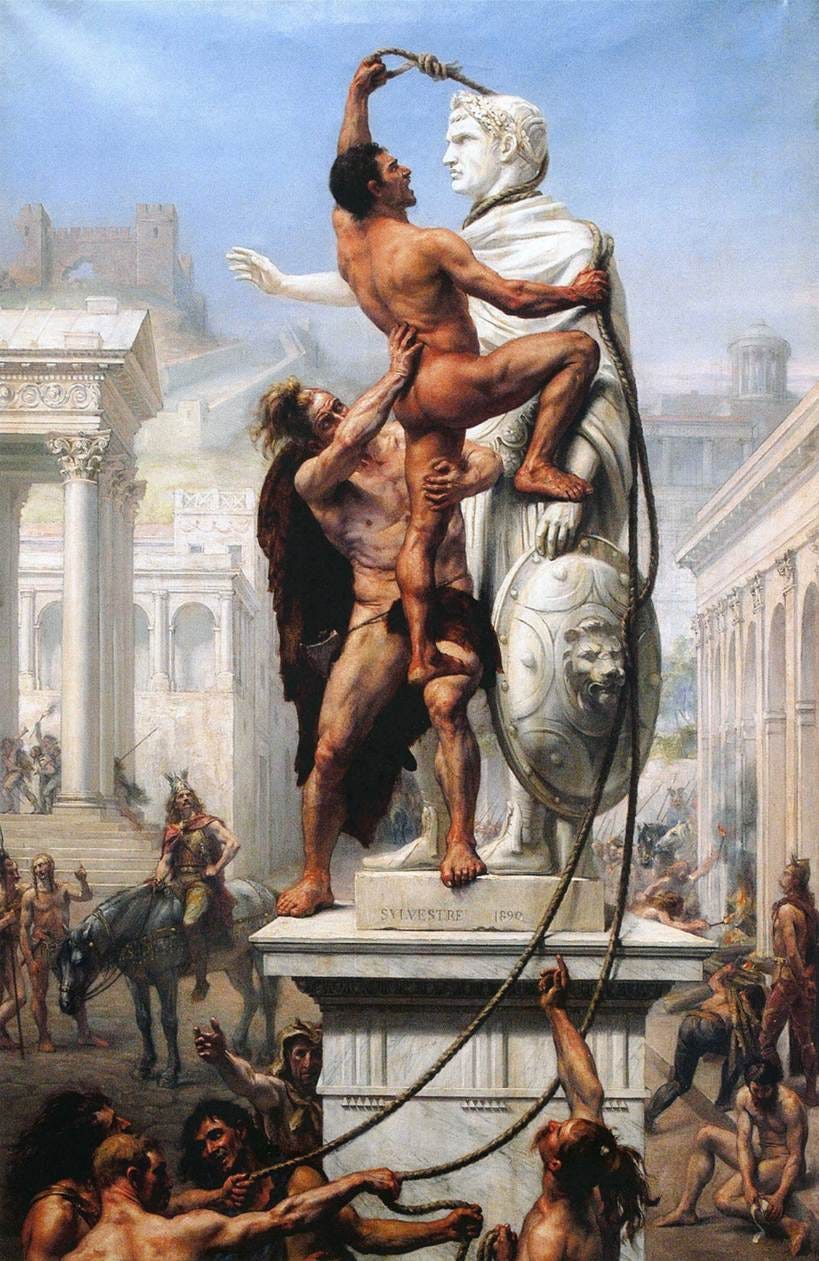
It’s important to note, however, that the “barbarism” Bordiga invokes here in a tongue-in-cheek fashion is ultimately a romantic artifice of civilization itself. Joseph-Noel Silvestre’s painting, “The Plunder of Rome,” which depicts the very events Bordiga references, is my favorite illustration of this theme, depicting “barbarism” as a form of simple heresy that (whether in its romantic or xenophobic variant) helps to constitute the very civilizational process against which it initially seems to be posed. The painting is, in simple terms, not good. An academicist, Silvestre’s style is wooden and his themes doubly derivative: a late-modern, synthetic imitation of the classical painters who were themselves imitating grand themes from antiquity (academicism was always the “AI slop” of its era). Ironically, however, this is precisely what makes the painting so interesting: its synthetic, saccharine symbolism, childish romanticism, and of course its Manichean composition counterposing the ruddy, smoke-smudged “barbarity” of the Visigoths to the clean, rectilinear white marble of Rome. Precisely because it is overloaded by its own self-evident artifice, the piece unintentionally communicates a deeper point: heresy is always a construct of and vehicle for civilizational power.
Marxism is itself plagued by periodic afflictions of a similar character, in which the simplistic heresies generated by capitalist civilization enter the body of theory and burst out in stinking pustules of vulgarity—reducing the critical thrust of the Marxian project to a mechanical imitation of itself. Crucially, these Marxisms are “vulgar” not simply in the sense of being wrong interpretations but because they embrace the very fantasies cast behind capital as its own ideological shadow and, more importantly, because these were themselves the target of Marx’s own sustained critique: utopian socialism, political economy, “great man” theories of history, economism (i.e. “trade union consciousness”), the republican obsession with the civic sphere, etc. In other words, “vulgarity” in this specific sense refers to the perverse logic through which the object of critique perpetuates itself by taking on the name of its own critic.
Marxism is itself plagued by periodic afflictions of a similar character, in which the simplistic heresies generated by capitalist civilization enter the body of theory and burst out in stinking pustules of vulgarity—reducing the critical thrust of the Marxian project to a mechanical imitation of itself.
Perhaps the most obvious example of “vulgarization” in this sense is the reduction of historical materialism to a simple theory of clear-cut sequential stages of social development solely determined by economic factors, in which the “primitive communism” of hunter-gatherer societies is replaced by slave-based and then feudal modes of production after the Neolithic agricultural revolution, with each shift in the “relations of production” determined by the further development of the “forces of production”—a position that Søren Mau refers to as “productive forces determinism.” This simplistic schema was originally derived from utopian socialists such as Saint-Simon, rooted in the historical theories of earlier French political thinkers as Antoine Barnave. These early determinist accounts were Marx’s own starting point and, in the early stages of his critique of political economy (beginning in the late 1850s), he himself adopted key features of this narrative.[3] Over time, however, Marx abandons the approach: “After the publication of the French edition of the first volume of Capital (1872-75) – the last edition Marx prepared – productive force determinism disappears entirely from his writing.” In fact, this position itself became an object of his critique. By the end of his life, he openly ridiculed “Marxists” making similar claims and “explicitly opposed determinist readings of his work.”[4]
Today, Haff’s theory of technical agency as the driving force of history serves a similar function as the productive forces determinism widely adopted within the early socialist movement. The work of Vaclav Smil (also addressed in the second chapter of Hellworld) is another case in point, stripping history of its social aspect and instead presenting it as little more than a sequence of “great inventions.” All of these accounts, including those that have appropriated the name “historical materialism” for themselves, are, in fact, contrary to the basic thrust of Marx’s own historical materialist method. As noted by Mau, “productive force determinism relies on the unwarranted assumption of a transhistorically necessary tendency for the productive forces to develop, regardless of the specific relations of production under which they are put to use – an assumption which is essentially external to Marx’s general theoretical framework.”[5] Similarly, Marxist social scientist John Milios argues that “This progressivist-teleological approach is … alien to the main tenets of Marx’s theoretical analysis as developed in Capital and his other mature ‘economic’ writings.”[6]
By contrast, the theory of historical materialism should be understood as nearly the exact opposite. According to Mau: “What drives history is not the immanent and necessary development of the productive forces, but human beings acting within a set of determinate social structures from which certain tendencies arise.”[7] In other words, a “social” or even “social-metabolic” materialism in which “technical” capacities are subordinate to social imperatives interfacing with (in fact, co-producing) ecological ones. Though early communist figures like Lenin and Bordiga seem to have clearly grasped this distinction, it was not until the 1960s that it would take on a clear articulation. In opposition to the orthodox version of progressive forces determinism adopted in the later Soviet Union, Chinese communists began to treat the “relations of production” as the driving force of history, rather than technical change alone. According to Mao: “First the production relations have to be changed, then and only then the productive forces can be broadly developed. This rule is universal.”[8] This reversal would soon serve as the groundwork for the Cultural Revolution.
Reflecting on events in China, Charles Bettelheim elaborated on the idea in more detail:
In the combination of productive forces/production relations, the latter play the dominant role by imposing the conditions under which the productive forces are reproduced. Conversely, the development of the productive forces never directly determines the transformations of the production relations; this transformation is always the focus of intervention by the contending classes – that is, of class struggle.[9]
And yet this reversal of dependent and independent variables is perhaps too straightforward, taking the “heretical” path of a simple inversion rather than a systematic rethinking. The position put forward first by Mao in the 1960s and then reiterated by Mau in the 2020s ultimately risks overcorrecting in the opposite direction and placing too much emphasis on purely subjective factors. This was, after all, arguably one of the major failings of the various “Maoist” currents that formed through the export of Chinese communist theory across the world, of which Bettelheim is one expression. Instead of a purely social or purely technical account, the social materialist approach sees class conflict as simultaneously produced by and playing out on a technical and ecological terrain that is itself being continually produced and reproduced by class conflict itself.
This dialectical intertwining of determinate social structures, non-human systems, and the specific technical capacities linking the two is the defining feature of the “mode of production.” Though the social materialist approach to history is “materialist” in the sense that it is tracing out the dynamic link between material changes in the productive forces and ultimately subjective social factors, it is nonetheless this social dimension that gives ultimate form to the process of historical development, including the material development of technology and of “new natures.” In Bettelheim’s formulation: “the system of productive forces only [exists] as an articulation within a system of relations of production which both dominates it and gives it its form.”[10] By the same measure, social dynamics are the ultimate cause inducing the shift between modes of production. It is therefore the “laws of motion” guiding these societies—their distinct “social logic”—that distinguishes distinct modes of production from one another and determines the social forms that prevail within them.
Marxist historian Jairus Banaji provides a succinct description:
By ‘modes of production’, Marx meant forms of domination and control of labour bound up with a wider set of class-relations expressive of them and the social functions implied in them. He saw these general ‘forms’ and the class-divisions grounded in them as ‘historically created’, that is, specific to the period they belonged to, yet capable of subsuming often much earlier forms as an intrinsic part of their own (form of) development …[11]
As suggested in this quote and as Banaji exhaustively demonstrates in the work from which it is drawn (Theory as History), these modes of production do not evolve in straightforward stages of linear displacement determined by the transhistorical development of the productive forces. They are instead contested, conjoined, and riven by their own conflictual social dynamics.
Instead of a purely social or purely technical account, the social materialist approach sees class conflict as simultaneously produced by and playing out on a technical and ecological terrain that is itself being continually produced and reproduced by class conflict itself.
At root, this means that history is driven less by the deterministic arc of (technical, ecological, cultural, etc.) development and more by contingent social conflicts expressed within particular “conjunctures.” While technological and environmental factors certainly set a space of probability within which particular paths may be more likely than others (and some not possible at all), the path actually taken is ultimately decided by social dynamics and, above all, should be understood as an outcome of the class conflict—which is, in the end, a matter of constructing a concrete (and inherently collective) subjective force with “arms in hand,” as Bordiga says. As summarized by Marxist social scientist John Milios:
According to Marxist theory, which provides the scientific investigation of social evolution, opposing trends and tendencies toward alternative paths of evolution can be traced to nearly all conjunctures of historic significance, reflecting in each and every case the dynamics of a particular balance of class forces. An assortment of eventualities of historical evolution is therefore repeatedly formed, and is not an ‘iron necessity’ of a predestined path of historical continuity or change. A scientific study of history refers precisely to the uncovering of these potentials and eventualities, and the understanding of the specific conditions that favoured the ultimate prevalence of a specific trend which then materialized as a ‘historical event’.[12]
At root, then, the history of any given society must be viewed in its own moment, as a dynamic and fundamentally contingent form of order incorporating both the material environment and a certain subjective expression. Knit together, these social moments nonetheless form modes of production, defined as relatively stable forms through which the social metabolism is organized.
Rather than a transhistorical technical progress undergirding these modes, however, we might instead posit a looser, more conflictual, probabilistic, and stuttering pattern of increasing social complexity over time that, whether teleologically “necessary” or not, is nonetheless empirically observable in:
the gradually increasing spatial scope and sheer quantity of mass movement,
the similarly expanding ecological impact of social dynamics
the very increases in technical complexity that appear, post facto, to have driven these social transformations.
the growing complexity of collective subjectivity—manifest as productive subjectivity in the division of labor and in growing knowledge of and ability to manipulate the physical world; and as political subjectivity in the more practically expansive and theoretically intensive forms of political expression and organization needed to address the emergent conflicts arising from the latter trends
In the prevailing civilizational discourse, social complexity as such is actively conflated with social domination. This is a point of continuity linking together thinkers of the status quo across space and time. The argument is therefore repeated by contemporary theorists of “complex systems”—as in the case of Haff’s “technosphere,” explored in Chapter 2 of the book—by social reformers like Keynes, by classical political-economic thinkers like Adam Smith, by political philosophers like Hegel (at least in his late work), and in even older theorists of statecraft that emerged from antiquity. In all of these accounts, social complexity is seen as necessitating social domination. Obviously, this is not true: egalitarian societies just as complex as their non-egalitarian neighbors have existed in the past and can exist in the present. Explaining this point is itself an important undertaking.
But this conflation of complexity and domination is nonetheless made easier by the fact that social domination does, in fact, operate through the technical and ecological systems that constitute the social metabolism. As a consequence, social domination is woven into the fabric of this metabolism in different ways in different modes of production. Understanding exactly how this works then allows us to better grasp the deeper nature of capitalism as but one in a long iteration of civilizations founded on the rule of a social elite whose power is rooted in control over the metabolic interface with the nonhuman world. More importantly, this then allows us to perceive the minimal conditions necessary for that multitude of people “organized with arms in hand” to not only destroy capitalism but to annihilate social domination as such at the planetary scale, thereby inaugurating an entirely new era for all of life on Earth.
[1] Jasper Bernes, The Future of Revolution: Communist Prospects from the Paris Commune to the George Floyd Uprising, New York: Verso, 2025. p.125
[2] Amadeo Bordiga, “Onwards, Barbarians,” 1951. <https://libcom.org/article/onwards-barbarians>
[3] Productive forces determinism was encoded as the “orthodox” Marxist position by the rightwing of the global socialist movement. But the position was not conjured out of thin air. Early texts such as the Contribution to the Critique of Political Economy (published in 1859 as For a Critique of Political Economy) invoked productive forces determinism, as did a number of Marx and Engels’ own (never-published) drafts. Particularly noteworthy is the process through which texts like the German Ideology were constructed by later editors, and for what purposes. On this topic, see: Terrel Carver and Daniel Blank, Political History of the Editions of Marx and Engels's "German Ideology Manuscripts." New York: Palgrave Macmillan, 2014.
[4] Søren Mau, Mute Compulsion: A Marxist Theory of the Economic Power of Capital, New York: Verso, 2023. p.108
[5] Mau 2023. p.108
[6] John Milios, The Origins of Capitalism as a Social System: The Prevalence of an Aleatory Encounter, New York: Routledge, 2018. p.21
[7] Mau 2023. p.108
[8] Qtd. in Milios 2018, p.22
[9] Qtd. in Milios 2018, p.23-24
[10] Qtd. in Milios 2018, p.23
[11] Jairus Banaji, Theory as History: Essays on Modes of Production and Exploitation, Chicago: Haymarket, 2011. p.1
[12] Milios 2018. p.3
Just a handyman who can barely hang on with these essays. Got about fifteen tabs up to go through these chronologically as well as check out many of the links you include (reading Endnotes article next). Anyway, the last sentence of this one is what I'm here for, so let's keep trying to digest!
Phenomenal essay. Really helpful on the relation between social forms and technology/production. I was particularly struck by this part:
This dialectical intertwining of determinate social structures, non-human systems, and the specific technical capacities linking the two is the defining feature of the “mode of production.” Though the social materialist approach to history is “materialist” in the sense that it is tracing out the dynamic link between material changes in the productive forces and ultimately subjective social factors, it is nonetheless this social dimension that gives ultimate form to the process of historical development, including the material development of technology and of “new natures.”
Could you give an example of how this has played out in recent history (eg with social media)?